
Fascism vs. Communism vs. Socialism: Differences Explained
https://examples.yourdictionary.com/fascism-vs-communism-vs-socialism-differences-explained
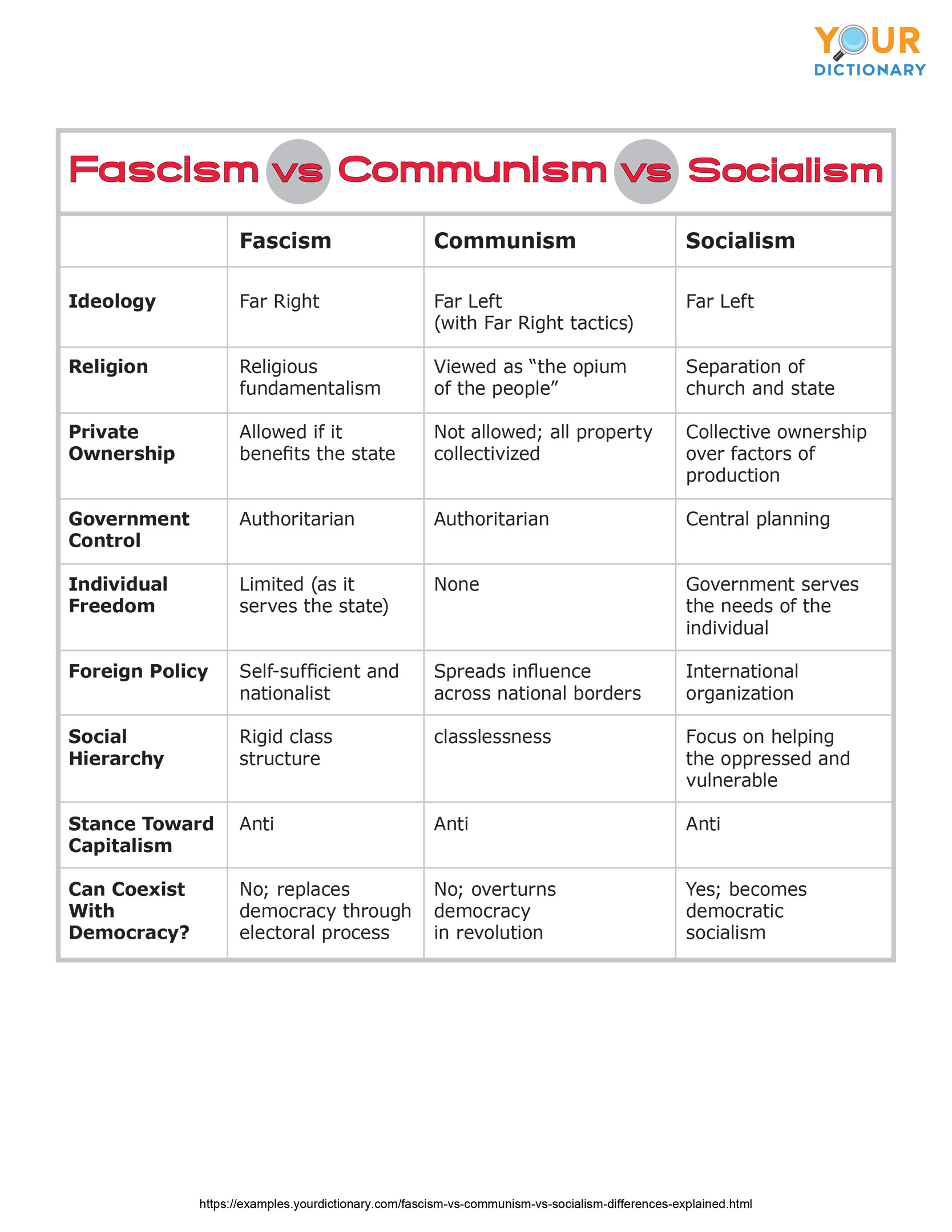
You may have heard the terms fascism, communism and socialism when describing an overcontrolling government. They are different from a democratic government and a capitalist economy, but they are also different from each other. Keep reading to learn the differences between fascism vs. communism, fascism vs. socialism and communism vs. socialism.
What Is Fascism?
Fascism is a government system led by one person, a dictator, who has complete power over the country. It’s also known as a totalitarian government. Citizens of fascist countries must surrender their individual liberties and pledge extreme allegiance to their leader.
Origins of Fascism
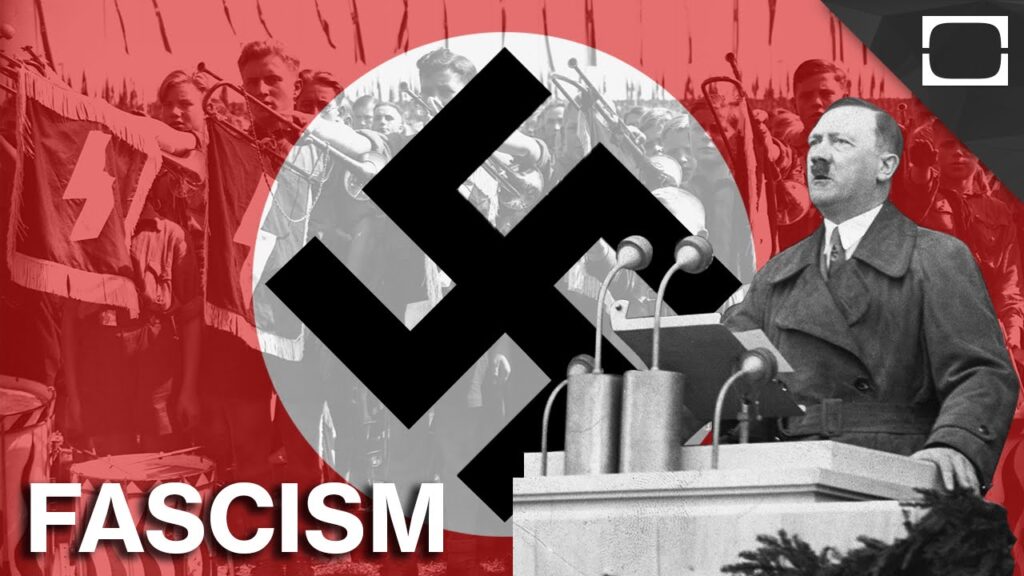
Benito Mussolini created the one-party fascist state in post-World War I Italy. His concept of fascismo is based on the Latin word fasces (“bundle of sticks”) which was favored in ancient Rome as a symbol of strength, as a bundle of sticks is much harder to break than a single stick. The rise of Mussolini’s National Fascist Party is just the first of many historical examples of fascism.
Principles of Fascism
When you call someone a fascist, you’re commenting on their oppressive nature. But there’s a lot more to the differences between fascism vs. communism or fascism vs. socialism. The principles of fascism include:
- Anti-Neutralism – Fascists do not believe in seeing “both sides” or staying neutral; you’re either with them or against them.
- Anti-Union – Labor unions are illegal in fascist nations, and are replaced by government-controlled labor organizations.
- Autarky (economic self-sufficiency) – Fascist countries reject both economic socialism and the free market of capitalism and prefer to be completely self-sufficient without relying on other nations.
- Economic Regulation – The government controls economic activity. It allows private profit — as long as that profit benefits the state.
- Far-Right Ideology – Fascism falls on the far right side of the political spectrum, favoring racial purity, religious fundamentalism and limited personal freedom.
- Nationalism – Citizens must put the country before their own interests, and the nation puts its own needs before all other nations.
- Social Hierarchy – Those in a fascist nation don’t believe in equality. They believe that class conflict is important to maintaining order in the nation.
- Strength – Fascist governments are militaristic, and they use violence and brutality to demonstrate their strength on the world stage.
- Victimhood – The country sees itself as a victim of other nations’ cruelty. It believes that it can do whatever is necessary to right the wrongs done by other nations.
Advertisement
What Is Communism?
Unlike fascism, a communist government focuses on equal treatment and opportunities for all citizens. It opposes capitalism, which encourages private profit and the empowerment of the individual. The philosophy of communism includes spreading its influence across country borders.
Origins of Communism
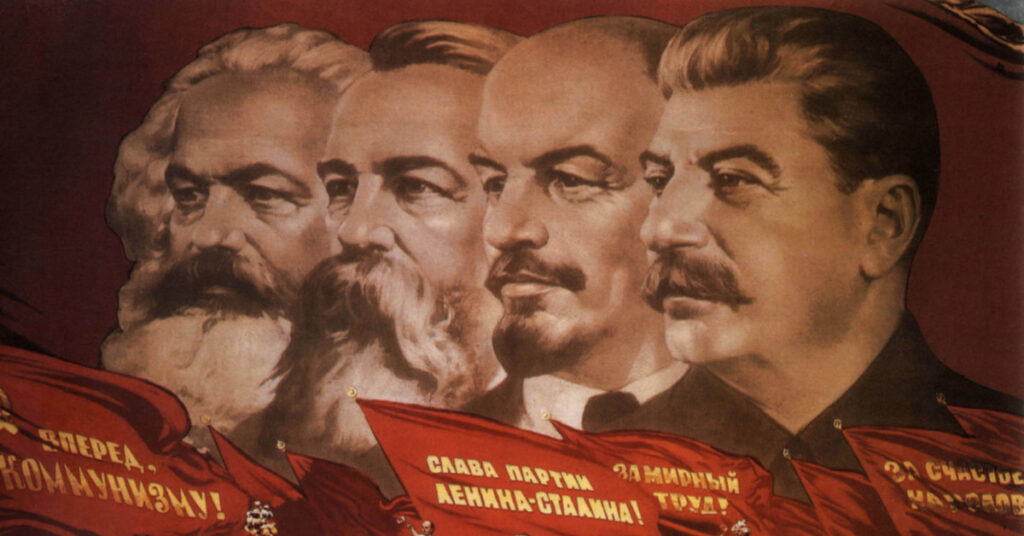
The word communism comes from the Latin communis, which means “common” or “universal.” The concept of an egalitarian society without classes or economic privilege has roots in ancient Greece, the European Renaissance and the Age of Enlightenment. However, it was Karl Marx and Friedrich Engels who defined modern communism in their 1848 pamphlet The Communist Manifesto. In one of the most famous examples of communism, Vladimir Lenin’s Bolshevik party took control of Russia in the 1917 Bolshevik Revolution.
Principles of Communism
The most basic tenet of communism indicates that workers who are responsible for producing wealth should have a share of that wealth. But there are more important principles in a communist government, including:
- Anti-Capitalism – In communist governments and economies, there is no free market or private profit. Communists reject what they perceive as selfishness and greed in capitalism.
- Anti-Religion – Marx regarded organized religion as “the opium of the people” because it prompts workers to accept capitalist oppression as part of their god’s plan.
- Authoritarianism – The first phase of a communist state is the revolution, followed by a period of authoritarian control (phase 2) before surrendering control to the people (phase 3). However, no modern communist state has been able to move from phase 2 into phase 3, as leaders have held on to their control.
- Classlessness – Communists believe in a society that doesn’t have social or economic class divisions (such as bourgeoisie vs. proletariat). The state is run by members of the working class in the interest of the working class.
- Collectivism – Communist countries demand that all property is turned over to the state to be shared with all citizens.
- Government Control – Communists believe that the government must intervene heavily in citizens’ lives to keep them from achieving more than others. This includes control over education, employment and even marriage and family.
- Far-Left Ideology, Far-Right Tactics – The concepts of social equality and sharing resources are a fundamental part of far-left ideology. However, the modern implementation of communism, including authoritarianism and limiting individual freedom, are closer to the right side of the political spectrum.
- International Influence – Communism is meant to be spread across the globe, not controlled within a country’s borders.
- Revolution – In order to achieve a communist utopia, the communist party must revolt against the ruling class — violently, if necessary. While some communists believe in reforming an existing government, most think that the entire structure must be overthrown and started again.
Advertisement
What Is Socialism?
Many people believe that socialism and communism are basically the same thing. While communism is a form of socialism, the two government systems are quite different in practice. Socialism can co-exist with capitalism, unlike communism, and does in most modern democracies (known as democratic socialism).
Origins of Socialism
The term socialism comes from the Latin sociare and the French social, meaning “to share.” It arose during the Age of Enlightenment as a reaction to Adam Smith‘s theory of capitalism. The movement gained popularity with Marx’s work in sociology and economics, and there are several examples of socialism found in 19th, 20th, and 21st-century politics.
Principles of Socialism
The clearest way to see the differences between communism and socialism are in their philosophies. Some of the main principles of socialism include:
- Central Planning – Purely socialist governments intervene in economic activity, rather than trust the “invisible hand” of the free market. This includes government-owned companies and price regulation by bureaucrats.
- Collective Ownership – Also known as “social” or “common” ownership, this principle contends that the factors of production (labor, goods, natural resources) should be owned by all members of a society.
- Cooperation over Competition – Socialists reject the competitive nature of capitalism. They embrace egalitarianism as the ideal way to ensure social stability.
- Distribution of Wealth – Socialist societies have high tax rates that are redistributed into government programs and infrastructure. It relates to Marx’s quote: “From each according to ability, to each according to need.”
- Equality of Opportunity – Socialism embraces the concept of social equality and fairness. It works to eliminate social and economic barriers based on prejudice or lack of access.
- Far-Left Ideology – Socialism can be as far left on the political spectrum as fascism is far right. Advocates of socialism often believe in the elimination of private property, a strongly regulated economy and well-funded government programs.
- Protecting the Oppressed – The principle of protecting those oppressed by other is seen as a responsibility of government. Examples of government programs aimed to help underserved members of society include universal healthcare and welfare programs.
- Separation of Church and State – Socialists support religious freedom but do not believe in a relationship between the state and any religion in particular.
- Workers’ Rights – Like communists, socialists support workers’ rights. But instead of a workers’ revolution, socialists advocate for labor unions and workplace regulations.
Advertisement
The Influence of Different Government Types
The difference between fascism vs. communism and fascism vs. socialism have come to define 20th and 21st century politics. But fascism, communism and socialism are only three types of government in the world. To contrast these types of government, learn more about how limited government functions, as well as its key principles and global examples. You might also want to understand some related terms like historic vs. historical.
Jennifer Gunner
Staff Writer
Related Articles
- Fascism Examples in History In simple terms, fascism is defined as a government structure where one dictator has complete control of the entire country, state, or territory. Anyone who opposes this dictator is suppressed and individual rights are often oppressed. A fascist government might also be called totalitarian.
- Different Types of Government Around the World When it comes to types of government, it can be difficult to classify systems in a single word. Governments are ever-evolving, which means national governments are composed of several types. Explore examples of different types of governments found around the globe.
You Might Also Like
Totalitarianism, Authoritarianism, and Fascism
https://www.thoughtco.com/totalitarianism-authoritarianism-fascism-4147699
What Is the Difference?
Understanding Types of Government
- Popular Government
- Elite Government
- Monarchies
- Totalitarian States
:max_bytes(150000):strip_icc():format(webp)/italian-fascist-youth-2698633-59887c4faad52b0010e29e14.jpg)
Table of Contents
- What Is Totalitarianism?
- What Is Authoritarianism?
- Totalitarian vs. Authoritarian Governments
- What Is Fascism?
By
Updated on March 02, 2022
Totalitarianism, authoritarianism, and fascism are all forms of government characterized by a strong central rule that attempts to control and direct all aspects of individual life through coercion and repression.
All nations have an official type of government as designated in the U.S. Central Intelligence Agency’s World Factbook. However, a nation’s own description of its form of government can often be less than objective. For example, while the former Soviet Union declared itself a democracy, its elections were not “free and fair”, as only one party with state-approved candidates was represented. The USSR is more correctly classified as a socialist republic.
In addition, the boundaries between various forms of government can be fluid or poorly-defined, often with overlapping characteristics. Such is the case with totalitarianism, authoritarianism, and fascism.
What Is Totalitarianism?
:max_bytes(150000):strip_icc():format(webp)/GettyImages-3425760-5c4ce47446e0fb000167c6d0.jpg)
Totalitarianism is a form of government in which the state’s power is unlimited and controls virtually all aspects of public and private life. This control extends to all political and financial matters as well as the attitudes, morals, and beliefs of the people.
The concept of totalitarianism was developed in the 1920s by Italian fascists. They attempted to spin it positively by referring to what they considered totalitarianism’s “positive goals” for society. Still, most Western civilizations and governments quickly rejected the concept of totalitarianism and continue to do so today.
One distinctive feature of totalitarian governments is the existence of an explicit or implied national ideology—a set of beliefs intended to give meaning and direction to the entire society.
According to Russian history expert and author Richard Pipes, Fascist Italian Prime Minister Benito Mussolini once summarized the basis of totalitarianism as, “Everything within the state, nothing outside the state, nothing against the state.”
Examples of characteristics that might be present in a totalitarian state include:
- Rule enforced by a single dictator
- The presence of a single ruling political party
- Strict censorship, if not total control of the press
- Constant dissemination of pro-government propaganda
- Mandatory service in the military for all citizens
- Mandatory population control practices
- Prohibition of certain religious or political groups and practices
- Prohibition of any form of public criticism of the government
- Laws enforced by secret police forces or the military
Typically, the characteristics of a totalitarian state tend to cause people to fear their government. Rather than trying to allay that fear, totalitarian rulers encourage it and use it to ensure the people’s cooperation.
Early examples of totalitarian states include Germany under Adolf Hitler and Italy under Benito Mussolini. More recent examples of totalitarian states include Iraq under Saddam Hussein and North Korea under Kim Jong-un.
According to Russian history expert and author Richard Pipes, Fascist Italian Prime Minister Benito Mussolini used the term “totalitario” to in the early 1920s to describe the new fascist state of Italy, which he further described as “all within the state, none outside the state, none against the state.” By the beginning of World War II, totalitarian had become synonymous with absolute and oppressive single-party rule.
Totalitarianism is typically distinguished from dictatorship, autocracy, or tyranny by its goals of replacing all existing political institutions with new ones and elimination of all legal, social, and political traditions. Totalitarian governments typically pursue a special goal, such as industrialization or imperialism, intended to mobilize the population in its favor. Regardless of the economic or social cost, all resources are devoted to achieving the special goal. Every government action is explained in terms of realizing the goal. This allows a totalitarian state the widest latitude of action of any form of government. No dissent or internal political differences are allowed. Because pursuit of the goal is the foundation for the totalitarian state, achievement of the goal can never be acknowledged.
What Is Authoritarianism?
:max_bytes(150000):strip_icc():format(webp)/GettyImages-595016647-5c4ce2f7c9e77c00016f34b9.jpg)
An authoritarian state is characterized by a strong central government that allows people a limited degree of political freedom. However, the political process, as well as all individual freedom, is controlled by the government without any constitutional accountability
In 1964, Juan José Linz, Professor Emeritus of Sociology and Political Science at Yale University, described the four most recognizable characteristics of authoritarian states as:
- Limited political freedom with strict government controls imposed on political institutions and groups like legislatures, political parties, and interest groups
- A controlling regime that justifies itself to the people as a “necessary evil” uniquely capable of coping with “easily recognizable societal problems” such as hunger, poverty, and violent insurgency
- Strict government-imposed constraints on social freedoms such as suppression of political opponents and anti-regime activity
- The presence of a ruling executive with vague, shifting, and loosely-defined powers
Modern dictatorships such as Venezuela under Hugo Chávez and Cuba under Fidel Castro typify authoritarian governments.
While the People’s Republic of China under Chairman Mao Zedong was considered a totalitarian state, modern-day China is more accurately described as an authoritarian state because its citizens are now allowed some limited personal freedoms.
Authoritarian leaders exercise power arbitrarily and without regard to existing laws or constitutional limitations, and typically cannot be replaced by citizens through freely conducted elections. The right to create opposing political parties that might compete for power with the ruling group is either limited or prohibited in authoritarian states. In this manner, authoritarianism stands in fundamental contrast to democracy. However, it differs from totalitarianism in that authoritarian governments typically lack a guiding national ideology or goal and tolerate some diversity in social organization. Without the power or necessity to mobilize the entire population in pursuit of national goals authoritarian governments tend to exercise their power within more-or-less predictable limits. Examples of authoritarian regimes, according to some scholars, include the pro-Western military dictatorships that existed in Latin America and elsewhere in the second half of the 20th century.
Totalitarian Vs. Authoritarian Governments
In a totalitarian state, the government’s range of control over the people is virtually unlimited. The government controls nearly all aspects of the economy, politics, culture, and society. Education, religion, the arts and sciences, and even morality and reproductive rights are controlled by totalitarian governments.
While all power in an authoritarian government is held by a single dictator or group, the people are allowed a limited degree of political freedom.
What Is Fascism?
:max_bytes(150000):strip_icc():format(webp)/GettyImages-525516186-ec8b2068b80a482e945e256119813d48.jpg)
Rarely employed since the end of World War II in 1945, fascism is a form of government combining the most extreme aspects of both totalitarianism and authoritarianism. Even when compared to extreme nationalistic ideologies like Marxism and anarchism, fascism is typically considered to be at the far-right end of the political spectrum.
Fascism is characterized by the imposition of dictatorial power, government control of industry and commerce, and the forcible suppression of opposition, often at the hands of the military or a secret police force. Fascism was first seen in Italy during World War I, later spreading to Germany and other European countries during World War II.
The Foundations of Fascism
The foundation of fascism is a combination of ultranationalism—an extreme devotion to one’s nation over all others—along with a widely held belief among the people that the nation must and will be somehow saved or “reborn.” Rather than working for concrete solutions to economic, political, and social problems, fascist rulers divert the peoples’ focus, while winning public support, by elevating the idea of a need for a national rebirth into a virtual religion. To this end, fascists encourage the growth of cults of national unity and racial purity.
In pre-World War II Europe, fascists movements tended to promote the belief that non-Europeans were genetically inferior to Europeans. This passion for racial purity often led fascist leaders to undertake mandatory genetic modification programs intended to create a pure “national race” through selective breeding.
Historically, the primary function of fascist regimes has been to maintain the nation in a constant state of readiness for war. Fascists observed how rapid, mass military mobilizations during World War I blurred the lines between the roles of civilians and combatants. Drawing on those experiences, fascist rulers strive to create a rabidly nationalistic culture of “military citizenship” in which all citizens are willing and prepared to take on some military duties during times of war, including actual combat.
In addition, fascists view democracy and the electoral process as an obsolete and unnecessary obstacle to maintaining constant military readiness. They also consider a totalitarian, one-party state as the key to preparing the nation for war and its resulting economic and social hardships.
Today, few governments publicly describe themselves as fascist. Instead, the label is more often used pejoratively by those critical of particular governments or leaders. The term “neo-fascist,” for example, describes governments or individuals espousing radical, far-right political ideologies similar to those of the World War II fascist states.Cite this Article

